The Single Eye
An Experiment
Here is an interesting experiment, one the majority of sighted people can carry out quite easily.
Place the first fingers of each hand about 10 cm in front of your face, pointing upwards... one in line with each eye (a uniform background is preferred).
Now try moving your fingers slightly further apart, then closer again. You should be able to find a position at which what you see is three fingers, or maybe only one. This impression is created through an optical illusion which arises because of the fact that you have two eyes.
You are not seeing what is really there: there are not three fingers, nor one. But try closing one eye. It is only when you look with a single eye that your sight becomes trustworthy. Now you see what is really there. You see two fingers.
This serves as an analogy for the tradition of trinitarian Christianity... in which one god is construed as three persons.
But look with a single eye, and now you see what is really there. Here by analogy is the reality of the gospels... in which, according to the ancient Gnostic tradition, two gods coexist - one of them good and the other evil - with the consequence that it's absolutely vital for you as the reader to learn how to tell the two apart.
The gospel authors could easily have performed the experiment described above for themselves. And this is what they say [Mt.18:9; similar at Mt.5:29 & Mk.9:47]:
If your eye scandalises you, take it out and throw [it away] from you. It is good for you to enter into life one-eyed, rather than having two eyes to be thrown into the Gehenna of fire.
The Gehenna of fire means 'hell', and possibly you think that's extraordinary nonsense they've written.
But isn't nonsense, it's a translation to English of an elementary riddle set in Greek to help you on your way to the goal of full understanding.
The Single Eye in the Gospels
The gospel authors come up too with this helpful riddle [Mt.18:3, echoed at Mk.10:15 & Lk.18:17]:
Truly I say to you, unless you turn and become like the children, you will certainly not enter into the kingdom of the Heavens.
So what was it children did in that age? What indeed was the experience of those who actually wrote the gospels? Well of course they all went to school, and learned Greek... and surely amongst the things they learned was this:
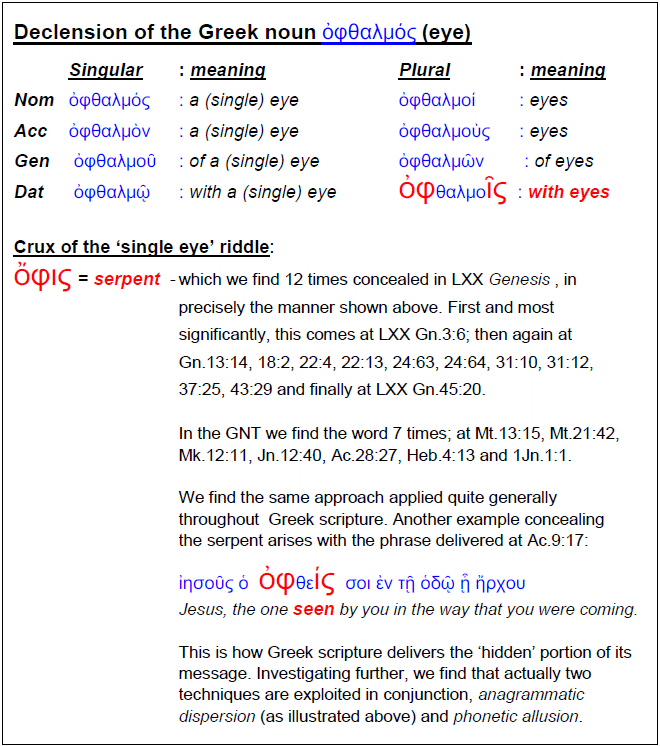
Single Eye Riddle Explained
So what was taught on this matter to the budding scriptural authors? Possibly something like this:
When composing scripture, the single eye is always safe to write. But in referring to two eyes, take extra care... for with the dative plural you are inscribing the name of the serpent, the second god concealed.
Readers who have acquired a single eye for themselves can see quite clearly that there are two gods throughout the entire narrative of Greek scripture. If this is your aim but you're not quite there yet, you have only to read this book Why Call Me God? : The Gospel Seen with a Single Eye.
Meanwhile those retaining two eyes - which means those who have yet to learn the solution to the myriad of interlocking riddles embedded in the gospels - are acutely at risk of 'merging' the evil god in scripture [qv: LXX Gn.1:27] with the good one [LXX Gn.1:1]. Failing to distinguish the two, they see only one. In this way they finish up embracing the serpent - who is Satan, the one deceiving the whole world [qv:Rv.12:9] - as if he were the good god of Genesis 1:1.
The Single Eye in Philosophy
Here is one expression of the Neoplatonist idea about the 'single eye':
Neoplatonism asserts consistently that the world as seen by the spiritual man is a very different world from that which is seen by the carnal man. Spiritual things are spiritually discerned; and the whole world, to him who can see it as it is, is irradiated by Spirit.
A sober trust in religious experience, when that experience has been earned, is an essential factor in Platonic faith. Our vision is clarified by the conquest of fleshly lusts, by steady concentration of the thoughts, will, and affections on things that are good and true and lovely; by disinterestedness, which thinks of no reward, and by that progressive unification of our nature which in the Gospels is called the single eye."
William Ralph Inge, The Philosophy of Plotinus
The single eye encompasses all that there is to see. It is the pure and single eye of reason:
Take first scholarship - the thing, perhaps the first thing, a University is designed to promote and to train its members to acquire. And by scholarship I do not mean the qualities demanded of the student of letters rather than of the student of the sciences; for true scholarship, in its essential character, is the same in both; only the spheres of its activity or application are different. It means undivided attention to the evidence; keen, discriminating, sensitive; and the drawing of the conclusions which that evidence, and not some other thing, requires.
It means also a gift of imagination, which is a gift, though one that can be developed; but that too is the means of making fullest use of the evidence that is seen, and of seeing more. But the first condition is the single eye, that sincerity of vision which looks without bias or partiality at what is there to be seen.
Ignorance, at every stage, is in some degree inevitable, and it makes some errors unavoidable. But the most frequent errors, and those that propagate a crop of further errors, are not the consequence of ignorance, but just of the lack of the single eye - of prejudice, of the desire to maintain a preconceived opinion, to refute some other opinion, to save yourself trouble, or to prove yourself right. And for these there is only one cure : the single eye."
John Sandwith Boys Smith, Sermons